

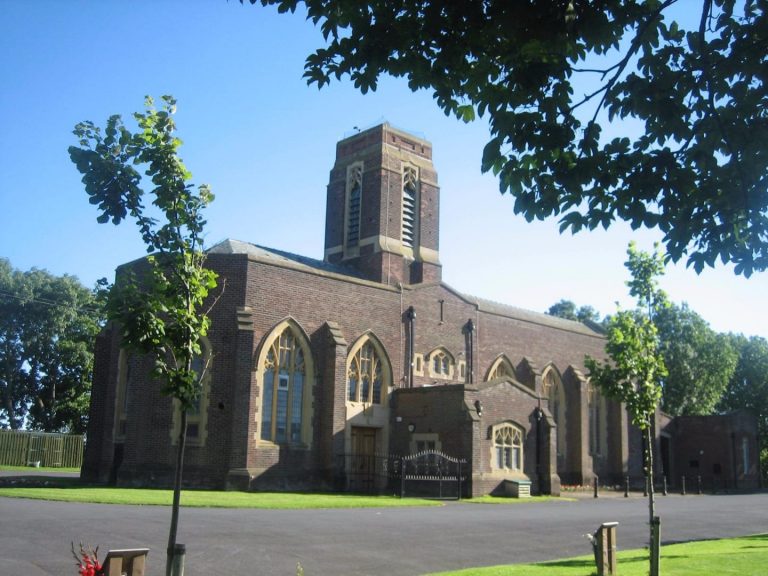
Carleton Crematorium and Cemetery opened on 18 July 1935. It’s the place where we say goodbye to our loved ones. Did you know that it’s also got a significance of its own?
Find it at: Stocks Lane, Poulton-le-Fylde, FY6 7QS
The graveyard is located within the Greenlands Ward of Blackpool, with the crematorium owned and operated by Blackpool Council. However, the main entrance is on Stocks Road in Carleton, Poulton-le-Fylde.
There’s pedestrian access to the cemetery 265 days of the year, 24 hours a day. However the main gates are open from 8am to 6pm. Enjoy a walk through the pleasant grounds and you’re welcome to bring your dog – providing it’s on a lead at all times and you pick up after it.
With many thanks to Denys Barber for this information and photos. And to Nick Moore and his fascinating History of Blackpool – read it here.
Carleton Crematorium – way ahead of its time
Considering that in the 1930s only 5% of funerals involved cremation, the building is way ahead of its time in terms of size, design, and setting.
It was only when the Royal Family and famous personalities showed an interest in cremation that it became less stigmatised.
FREE Newsletter
FREE Newsletter


Famous Cremations
One of the first famous people to be cremated at Carleton was the children’s author Beatrix Potter. She died on 22 December 1943 from a heart attack as a complication of severe bronchitis and pneumonia, at her home in Near Sawrey in the Lake District.

Unusually for the time, she’d decided her mortal remains were to be cremated following her death. After her funeral, her shepherd, Tom Storey scattered her ashes in the lake district.
Beatrix Potter was born in London in 1866. Her family took their holidays in Scotland and the English Lake District. Those lovely places stimulated her interest in natural science, countryside life and conservation. Combining with this her abilities as a writer and illustrator, she began to write illustrated books. They included beautiful paintings and sketches of the flora and fauna she saw.
Turning to children’s books, Beatrix Potter published her famous “Tale of Peter Rabbit”. Published in 1902 it was an immediate success. 30 more books followed, making her a household name. She was always at the forefront of modernity and conservation. To Beatrix, the countryside was something to preserve for future generations. She’s one of the pioneers of today’s Lake District National Park.
Other Famous Cremations
A number of famous people have been cremated at Carleton. Just some of them include: Charlie Cairoli, Jimmy Clitheroe and Violet Carson. Bernie Nolan, Lennie Bennett and Stanley Mortensen. Reginald Dixon, Tony Melody and John Comer.
Today, cremation accounts for more than 70% of funerals in this country.

Blackpool Council manage Carleton Crematorium. The main gates are in Poulton-le-Fylde in the Borough of Wyre.
History of Carleton Crematorium and Cemetery
The original Blackpool Cemetery opened in 1873, occupying about 5 acres on what at the time was called New Road (now Talbot Road). You’ll know it today as Layton Cemetery – a fascinating place with many historic tombs and monuments.
With 22,300 graves on site, including 400 war graves, today there are no longer any vacant burial plots at Layton Cemetery. In its lifetime, just over 50,000 people have been interred there.
A Replacement Cemetery for Blackpool
With Layton Cemetery full, the foundation stone for Blackpool’s replacement cemetery was laid by the Mayor on 5 February 1934. The opening of the Crematorium, Chapel and Garden of Remembrance was 18 July 1935, with the first cremation taking place on 25 September 1935.
Carleton Lodge once owned the land off Stocks Lane where Carleton Cemetery and Crematorium now stands. The main building is the design of legendary Borough Architect J.C. Robinson. He also designed Derby Baths, Blackpool Bus Station, Stanley Park Cafe, the Technical College, and Collegiate School. Robinson based it on his own interpretation of the Mausoleum of Mausolus. There’s a chapel at the north door which displays books of remembrance of those buried or cremated there.
Extended in February 1948 and again in August 2018 it now holds over 22,000 graves.
Carleton Crematorium burial ground, chapel and offices are also on Blackpool Council’s Local List of buildings of historical significance.
Are you as interested in local history as we are here at Visit Fylde Coast? Then you’ll enjoy the ‘History’ section on each of our websites. We know that we’ve only scratched the surface! Is there something you’d particularly like to see included? Just get in touch.
While you’re here…
Go to the homepage of the Visit Poulton website for the latest updates.
Enjoyed this article? Sign up for your email newsletter. Packed full of interesting things just like this, it arrives in your inbox all 52 weeks of the year.
Join us on Facebook at our Visit Fylde Coast Facebook Group and follow us on Twitter @visitFyldeCoast
Plus hundreds of videos to watch on our YouTube channel – from all over the Fylde Coast!
Booking a stay? Pick a safe, clean and legal place to stay, at the very best price. Book with the Visit Fylde Coast and StayBlackpool guide.

We Need Your Help
We Need Your Help





Hi this is Mr Paul Nelson from Birmingham, can you please tell me if I can view the remembrance
book in line as 1 of my ancestors was cremated here in 1937 a Mr FRANK CLEGG NELSON .
I visited Carleton Crematorium today 03/05/20 to lay flowers at my mothers tree/plaque and was appalled to see dog dirt at the edge of the path in front of my mothers plaque.. There is a clear notice on the front gate reminding dog owners of their responsibilities when walking their dogs and to remove the waste. Most dog owners take their responsibility’s seriously however some don’t and give dog owners in general a bad name.
The waste was pretty fresh so someone who has taken their dog their in the last 24 hours.
I attended a funeral at Carleton Crematorium today and was absolutely appalled.J C Robinson (the original designer) would be turning in his grave. At the entrance to the Crematorium there is now an “in your face” cremator which looks like Stephenson’s Rocket or something off an industrial estate. This is not something people who are saying farewell to a loved one want to see. It is totally out of character and looks like Battersea Power Station.Who is responsible for this blatant monstrosity? They have a great deal to answer for.They should be formally castigated.
The current temporary cremators, external to the main building, are an unfortunate consequence of the Council making a poor choice when replacing the crematorium plant 5 years ago. The 1930s Robinson-designed building is relatively tight on space behind the scenes, especially with tightening environmental regulations that require more treatment of cremator flue gases before discharge to atmosphere. The Council chose a company who said their cremators and treatment plant could fit in without significant modification to the building, however that company was relatively new to the UK market, and they went bankrupt part way through the installation.
The Council found an alternative company to finish the work and install the equipment that they had purchased, however those cremators have been dogged by unreliability and technical problems during the last 5 years service, increasing the workload on the technicians who carry out the cremations. Other local authorities who chose the same supplier as Blackpool have been similarly troubled. Two crematoria using the same equipment had suffered serious fires, many have had this sub-standard gear totally replaced. Others (e.g. Cheltenham) are building totally new crematoria.
The Robinson building is going to be extended (sympathetically, I’m told) to accommodate new plant from a leading and reputable supplier. In the meantime, the temporary “containerised crematory” is needed while the unreliable gear is dismantled, the building extended, and the new gear installed. Otherwise we would be looking at a lengthy 6 month closure. I don’t think Fylde, Preston and Lancaster combined can absorb Carleton’s service load for such an extended period without working significant overtime. I’m slightly surprised that the Council didn’t explore options for establishing the temporary crematory elsewhere to avoid causing distress or loss of dignity, and transfer the deceased in a mortuary ambulance following committal but logistically that may have proved very challenging.
Thank you to the Rabbit Patch for once again for a very interesting read. I love history, and reading about where we live and the round about places is really good.
Much love to you and Jane
Erica McNaughton