


The history of Poulton-le-Fylde is a lot more interesting than you might think. It’s a popular, small market town today, somewhat overshadowed by it’s bigger neighbours along the Fylde Coast. But hundreds of years ago it was the busiest place on the Fylde, long before Blackpool became so popular.
The photo above is an old view of Breck Road Poulton, thanks to Mel Jones. It dates to the early 1900’s. Thanks to local historian Mr Nick Moore and his comprehensive guide to all things Fylde Coast for the information in this page. Find his ‘History of Blackpool and the Fylde of Lancashire‘ here.
12,000 Years in the History of Poulton-le-Fylde
Poulton-le-Fylde has a long history, with evidence of human habitation from 12,000 years ago. People have found many examples of Roman archaeology in the area. The township of Poulton appears to have begun in Roman times, probably around a small garrison of troops. Plus the complete 12,000 year-old skeleton of an elk, killed by hunting barbs. It’s the earliest ever evidence of human habitation so far north, from a time when England was still connected to Europe. More here about the Carleton (or Poulton) Elk
Fast Forward to the Middle Ages
After the Norman invasion, religion played a large part in how the area developed. Land was frequently given, leased, bought and sold. Abbots, priors and the landed gentry parcelled land out in many ways, but records are scarce.
At the time of the Norman Conquest in 1066, what we now know as Lancashire had a sparse population of 10,000 and the small town of Preston was the only significant community. Today, the population of Lancashire is about 1.6 million! Known as the ‘Hundred’ of Amounderness, from the late Saxon period onwards, ‘hundred’s was how most English counties were divided. The Saxon period lasted from 410 to 1066. It was a time when people kept to small tribal groups, forming kingdoms and sub-kingdoms. In the nineteenth century, hundreds were abandoned as administrative areas, with a few exceptions.
The village also had a Moot Hall in the town square where the area’s Justices met. ‘Moot’ comes from the Saxon ‘mote’ – a meeting place.
By 1086 Poulton was recorded as Poltun. This name comes from the Old English words pull or pōl + tūn meaning “farmstead by a pool or creek” or a ‘pool town’. Poulton was the port of the Fylde, with the local Custom House and the two wharves of Skippool and Wardleys. The trade on the River Wyre is its real foundation as a market town.
FREE Newsletter
FREE Newsletter

Market Day in Poulton
The town held regular markets. An annual horse market and a thrice yearly cloth market – on the 6 Feb, 13 April and in August. A cattle market was originally fortnightly (but by 1830 had become an annual event, held on 3 November). A weekly corn market held on Mondays had become a general market by 1850. There’s still a general market on Mondays today. Although markets taken place for for many centuries, Poulton never received an official market charter.
It also had its own ‘shambles’ next to the Moot, and a tithe barn – demolished in 1968 and replaced by a car park. Originally where local farmers paid a ‘tithe’ or tenth of their produce in tax, by 1822 it had become a theatre, mainly used by troupes of travelling actors.
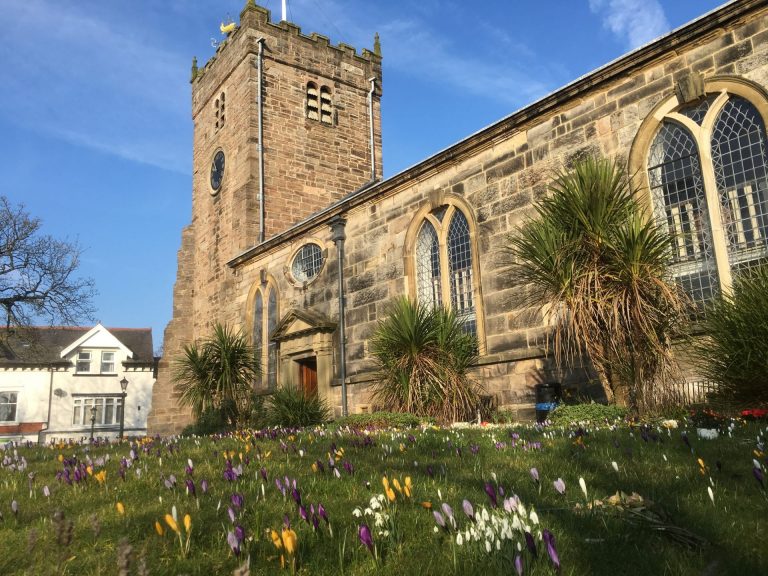
St Chad’s Church was recorded in 1094, at the time when it was endowed to Lancaster Priory. By the end of the Medieval period in the 1450’s, the area was thriving.
The Metropolis of the Fylde
Until 1837, goods were brought in and traded through harbours at Skippool and Wardleys Creek. These twin ports stood on each side of the River Wyre. At this point in the history of Poulton-le-Fylde, it was known as ‘The Metropolis of the Fylde’.
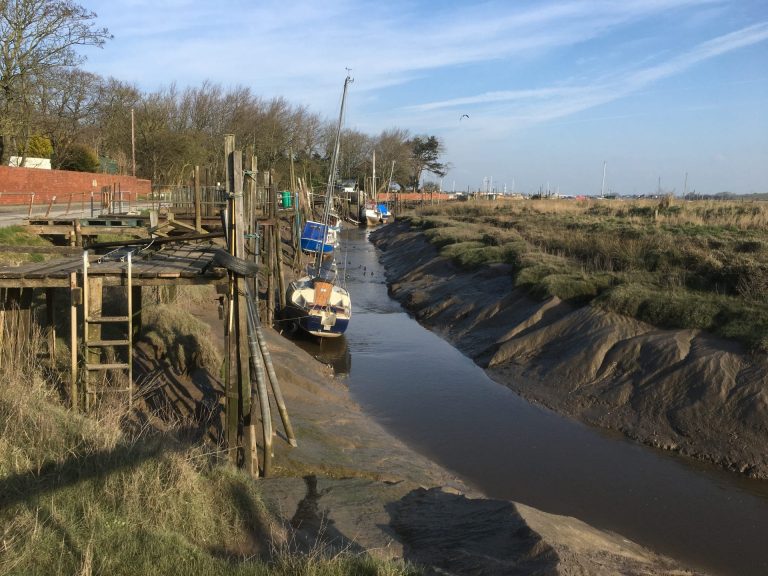
Imported goods came from all around the world, from as far afield as Russia and North America. Records from 1806–08 show that Poulton imported limestone and oats from Ulverston and coal from Preston. Cheese made in the area was exported back to the same places. Flax was imported from Ireland and the Baltic, while timber came from across the Atlantic, and tallow from Russia.
The Fylde area had a large linen industry so the importation of flax through Poulton was essential. Linen merchants in Kirkham owned large warehouses at Skippool and Wardleys creeks. By the 19th century, craftsmen in Poulton were an important part of the industry. But the increase in mechanisation with the advent of the industrial revolution in the early 1800s set off the decline of craft industries.
The Origins of the name Poulton-le-Fylde
Over the years, Poulton’s been written in various different ways, including Pultun, Polton, Potton, Poolton and Poulton.
Le-Fylde (“in the district called the Fylde”) came later in 1842 with the arrival of the Penny Post. It was a way to distinguish our Poulton from the more northern village of Poulton-le-Sands. That’s now part of Morecambe.
It’s not clear where Poulton got its market town status from as it was never granted a market charter. Markets were held by prescription. The market cross probably dates from the 17th century.

The Fading History of Poulton-le-Fylde
As Blackpool and Fleetwood began to grow and develop in the mid 1800’s, the importance of Poulton started to fade.
The railway line connecting Fleetwood with Preston was completed in 1840, with Poulton as one of the stops. But Fleetwood immediately superseded Poulton as a port, and the Customs House was also moved to Fleetwood. But Poulton did get an initial commercial benefit from the rail link. The importation of Irish and Scottish cattle through Fleetwood meant that a fortnightly cattle market could be held in the town.
The Growth of Blackpool
At the same time as all this development, Blackpool was growing as a resort.
During the construction of the railway network, visitors travelled first by rail to Poulton. They carried their journey on to Blackpool by horse-drawn charabancs or omnibuses. But with the railway line between Poulton and Blackpool completed in 1846, visitors could travel by train straight to the country’s finest seaside town. And so, as they say, the rest is history!
Find out More
Has this brief overview of the history of Poulton whetted your appetite to find out more?
Poulton Historical and Civic Society is a local group. They’re interest is in the history and heritage of the area, and making the past accessible to all.
Nick Moore is a local historian who has written the most comprehensive guide to all things Fylde Coast. A lot of the information in this website comes from his work. Find his ‘History of Blackpool and the Fylde of Lancashire‘ here.
Old Photos of Poulton
We’ve been collecting old local photos together, both here on this website and on our Pinterest page. Why don’t you take a look:
While you’re here…
Go to the homepage of the Visit Poulton website for the latest updates.
Enjoyed this article? Sign up for your email newsletter. Packed full of interesting things just like this, it arrives in your inbox all 52 weeks of the year.
Join us on Facebook at our Visit Fylde Coast Facebook Group and follow us on Twitter @visitFyldeCoast
Plus hundreds of videos to watch on our YouTube channel – from all over the Fylde Coast!
Booking a stay? Pick a safe, clean and legal place to stay, at the very best price. Book with the Visit Fylde Coast and StayBlackpool guide.

We Need Your Help
We Need Your Help


Looking for information about family named either Tarry or Wright who I believe ran the working men’s/ conservative club or maybe the Ship Inn from 1900s
Hello!
I am researching my family’s history, and this has taken me back to the baptism of John Warbrick on 15th January 1766 at St Chad’s Church, Poulton Le Fylde. His father, William Dixon, lived in Thornton and his mother, Isabell Warbrick, lived in Breck in Poolton. Can you give me any information about these two places, please? Were they villages on the outskirts of Poulton Le Fylde? Or was Poolton an alternative spelling of Poulton? My information was gained from the Lancashire Online Parish Clerks website. Thank you.
I think it’s an alternative spelling. More about Thornton here: https://www.visitcleveleys.co.uk/recreation-entertainment/explore/thornton/ ‘Breck’ is still used to describe part of Poulton, named after the breck (stream) that feeds into the River Wyre. More about St Chad’s here: https://www.visitpoulton-le-fylde.co.uk/about/history/st-chads-church/ Root around the individual Visit Fylde Coast websites (access them from the top menu) and there’s loads of local information both now and past history. Good luck!
I was brought up in Poulton and all family on my Mum’s side were born there. My grest grandfather worked i the signal box in Poulton station. I now live in Spain,but come back for visits. I had two books about Poulton history that got lost in the move,and I would love to be anle to buy them again. Could you please advise me where to get them.
Have you tried Amazon? You can usually find most things there